| October 17, 2025 | 5 min read |
| |
|
Hello, it's me again. Technology and financial markets have become deeply entwined. If you're like me, you're obsessed with both. So don't forget to sign up for First Trade, a BI newsletter from executive editor Joe Ciolli, that launches on Monday. |
|
|
Source: Alistair Barr/ChatGPT
|
For nearly two decades, Amazon Web Services was the foundation of the internet’s first great building boom. Startups didn’t need to buy servers or manage data centers because AWS provided the infrastructure and tools for the cloud economy. But the rise of generative AI has ushered in Cloud 2.0, and the blueprints are changing fast. Internal Amazon documents reveal that AI startups have been delaying AWS adoption, diverting early budgets toward AI models and tools, inference platforms, and new “neoclouds” that sell GPU access, according to a blockbuster scoop from Business Insider's Eugene Kim. Instead of relying on AWS for traditional cloud compute and storage, founders are starting with OpenAI, Anthropic, and AI tool providers such as Vercel, along with specialized GPU providers like CoreWeave. For AWS, that’s a seismic shift: the startup ecosystem that once fueled its dominance is now building elsewhere first. This is not me telling you this. It's in Amazon's own words. Back in 2023, I told you how the Cloud 2.0 era is defined by a new stack of specialized hardware, models, APIs, and developer tools. Many of these are outside the control of traditional cloud giants, and they are less sticky than traditional services such as compute, storage, databases, and analytics. This could be one reason AWS growth has lagged other cloud providers that have more AI goodies to offer startups. Take the second quarter of this year. Microsoft and Google generated cloud revenue growth of more than 30%, while AWS was under 20%. Newer AI cloud specialists are growing 200% or more, albeit from a lower base. Don't get me wrong: AWS is still the cloud king with the most market share. It has promising AI partnerships, especially with Anthropic. Yet as AI reshapes startup spending priorities, the question is whether AWS will still sit on this throne in five or 10 years' time. |
|
|
Other BI tech stories that caught my eye: |
|
|
My take on who's up and down, including updates on tech jobs and compensation. |
- UP: The AI gloom lifted a bit from Salesforce this week, after the software company issued rosy guidance.
- DOWN: Hewlett Packard Enterprise, which sells data center gear, dropped more than 10% on Thursday on a much less-rosy forecast.
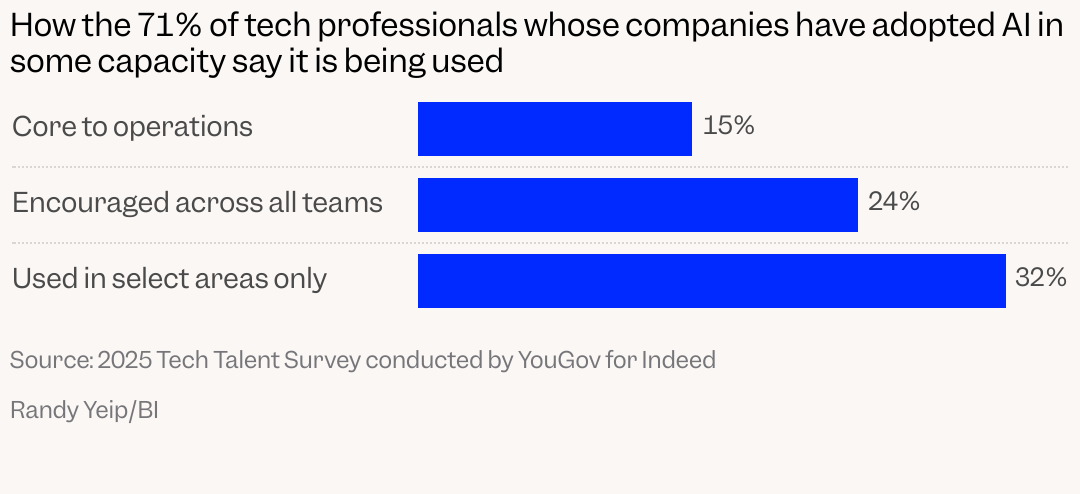
- TECH JOB UPDATE: With YouGov's help, Indeed surveyed more than 1,000 tech workers between May 22 and June 10 to uncover trends in how AI is being adopted across the industry. The first takeaway: AI adoption is widespread, but integration is uneven. Overall, 71% of tech professionals say their company has adopted AI in some capacity, but the extent varies:
|
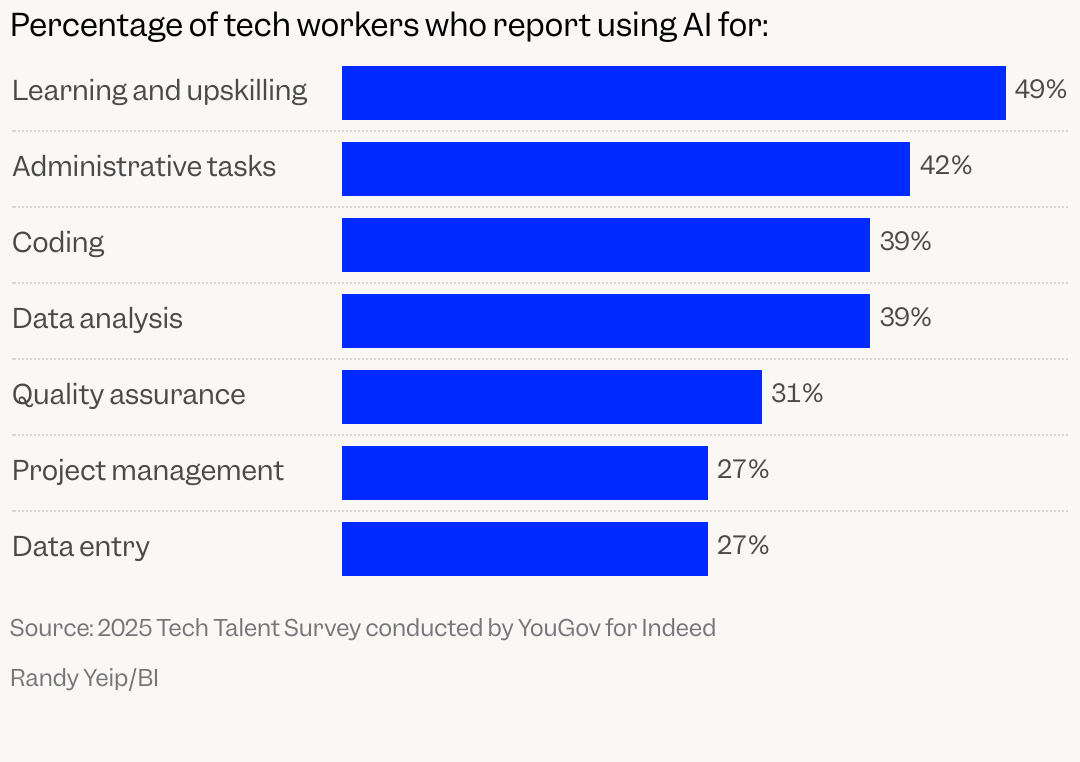
Most tech workers are incorporating AI into their daily workflows, some as a key part of their role, others more ad hoc: |
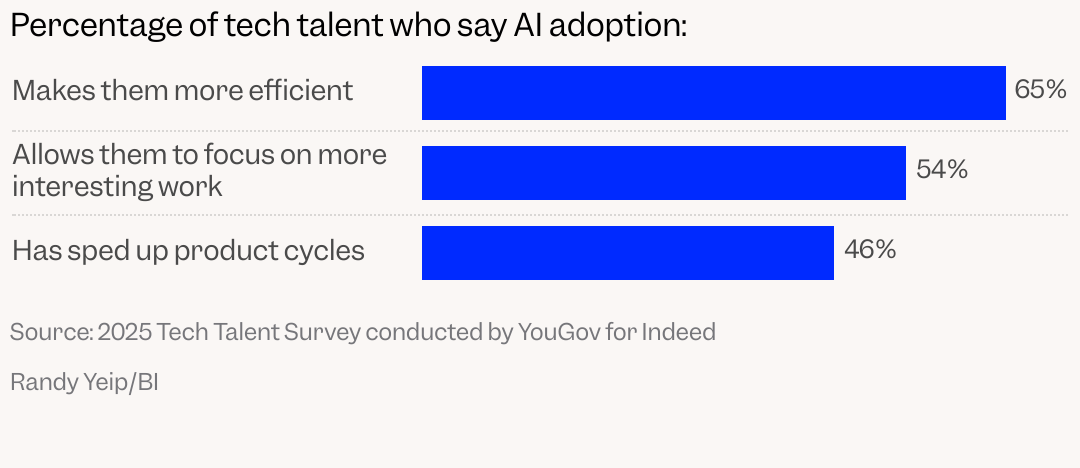
Finally, tech talent sees clear benefits to AI adoption. |
|
|
Other Big Tech stories I found on the interwebs: |
- Mark Gurman dishes details on a touchscreen MacBook. (Bloomberg)
- Would you want to "sign in with ChatGPT"? (The Information)
- Meta gains another AI expert, at the expense of Apple. (Bloomberg)
- Tim Higgins interviews Google's Search boss. (WSJ)
- Cloud giants are moving their supply chains away from China. (Nikkei)
|
|
|
This is the space where I feature folks trying an AI tool, or sometimes I test stuff out myself. What should I cover next week? Let me know. |
Jascha Kaykas-Wolff, the former CMO of Mozilla and BitTorrent, has watched tech revolutions sweep across industries for years. His latest project, Eleanore, a cannabis-infused cocktail launching in 2026, shows how generative AI is transforming brand creation. Four years ago, building a product like this would have required at least six months, $300,000 to $500,000, and multiple agencies and contractors. Instead, Kaykas-Wolff and his partner Alexandra Roberts made similar progress in about four weeks for less than 10% of the cost by treating AI as their core team. They use a suite of AI tools, including ChatGPT, Claude, ElevenLabs, and Lovable, to handle everything from strategy to design and operations. Customized GPTs named Tilda and Ferris serve as creative and business partners: Tilda helps Roberts translate her artwork and design language into digital assets, while Ferris supports vendor outreach, market modeling, and legislative tracking. AI now integrates tasks that were once spread across specialists — such as creative direction, financial modeling, web development, and compliance — collapsing months of linear work into iterative, same-day loops. Instead of briefing designers and waiting weeks, the pair can move from concept to launch materials in hours. Before generative AI, they would have relied on software services such as Adobe Creative Suite, Webflow or Squarespace, Figma, Mailchimp, and Google Analytics, likely coordinated by a team of five to seven people. Each revision cycle cost time and money; creative iteration was expensive and constrained. Today, AI removes that friction. It handles heavy lifting across workflows, enabling small teams to explore ideas that once demanded full departments. Lovable powers their website and integrates marketing tools without external developers; ElevenLabs helps craft the brand’s voice identity. Kaykas-Wolff sees Eleanore as proof that AI expands human creativity, rather than replacing it. "AI has turned small, creative teams into full-scale operators. What used to require entire departments can now be done by two people who understand how to collaborate with these systems," he told me. "It lets you explore ideas you would have abandoned before because of time, cost, or expertise." | |
|
I love hearing from readers. What do you want to see more of, or less of? Specifically, though: This week, I want to hear back about startup spending priorities. If you're a founder or startup employee, what are you spending on first? Let me know: abarr@businessinsider.com |
|
|
The Tech Memo team Alistair Barr, author, in San Francisco. Akin Oyedele, deputy editor, in New York. Dan DeFrancesco, deputy editor, in New York. Steve Russolillo, chief news editor, in New York. Get in touch. Email us at techmemo@businessinsider.com Get more Business Insider Subscribe for unlimited articles. Never miss a story when you download our app. |
|
|
|