A Practical Guide to Building AI Agents
To Nha Notes | April 28, 2025, 4:05 p.m.
With the rapid advancement of large language models (LLMs), AI agents are becoming central to modern applications. Unlike traditional software, agents independently manage complex workflows, make decisions, and interact with external systems on behalf of users.
This guide outlines when and how to build agents effectively. Agents are best suited for workflows that involve complex decision-making, frequent reliance on unstructured data, or where traditional automation has failed. Designing a successful agent involves three main components:
-
Model: The LLM responsible for reasoning and decisions.
-
Tools: APIs or functions the agent can call to take actions or retrieve information.
-
Instructions: Clear guidelines to control agent behavior, reduce ambiguity, and manage edge cases.
Key best practices include choosing the right models based on task complexity and cost, defining standardized tools, and writing detailed, action-oriented instructions. Proper orchestration—sometimes involving multiple specialized agents—ensures that workflows remain predictable, scalable, and safe.
By following these principles, teams can confidently build agents that perform reliably and add real business value.
How to Build a Scalable AI Agent
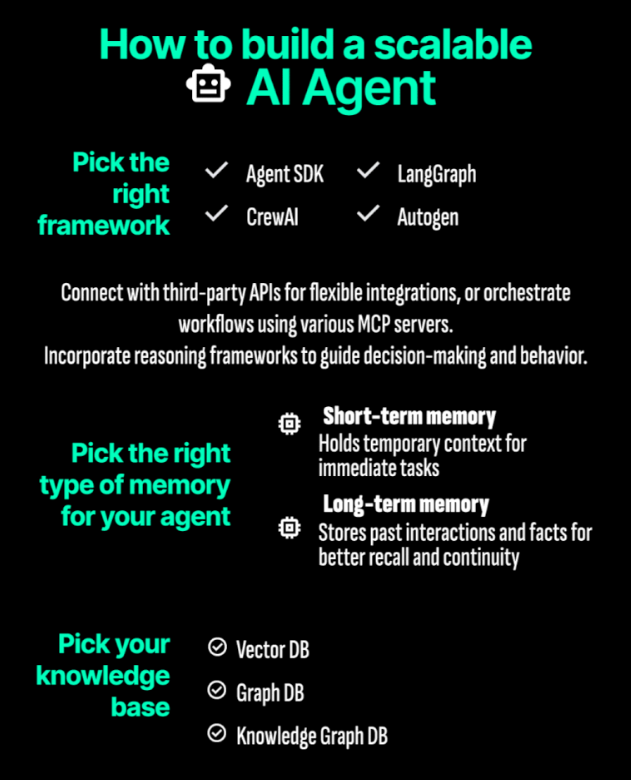
In the rapidly evolving world of artificial intelligence, building a scalable AI agent is no longer a luxury—it's a necessity for teams aiming to drive automation, enhance user experience, and streamline decision-making. Whether you're designing a virtual assistant, an autonomous research tool, or a complex decision-making system, scalability is key.
Here’s a high-level guide on how to architect a scalable AI agent from the ground up.
✅ 1. Pick the Right Framework
Choosing the right framework sets the foundation for how your agent operates and evolves. Today’s most effective AI agent frameworks include:
-
Agent SDK
-
CrewAI
-
LangGraph
-
Autogen
These frameworks allow seamless orchestration of workflows and support flexible integrations with third-party APIs and services. They also offer robust support for reasoning frameworks to help guide your agent’s decision-making and behavioral logic.
🧠 2. Pick the Right Type of Memory for Your Agent
Memory is what gives an AI agent continuity and contextual understanding. Choosing the right memory structure is crucial for both short-term task performance and long-term adaptability.
-
Short-term memory
Ideal for handling temporary context and immediate tasks. This is your agent’s working memory, enabling it to stay focused on the current conversation or problem. -
Long-term memory
Stores past interactions, decisions, and facts. This empowers your agent with better recall, more informed reasoning, and smoother continuity in user experiences.
📚 3. Pick Your Knowledge Base
A powerful AI agent needs a solid knowledge backbone. The right database architecture supports rich information retrieval and structured reasoning. Consider these options:
-
Vector DB – Efficient for similarity searches and semantic retrieval.
-
Graph DB – Great for modeling complex relationships and networks.
-
Knowledge Graph DB – Ideal for combining structured and unstructured data with meaningful context and ontologies.
References:
-
https://thenewstack.io/top-three-agentic-ai-use-cases-for-modern-it-operations/
-
https://thenewstack.io/ai-agents-a-comprehensive-introduction-for-developers/
-
https://thenewstack.io/ai-agents-a-comprehensive-introduction-for-developers/
-
https://thenewstack.io/a2a-mcp-kafka-and-flink-the-new-stack-for-ai-agents/
-
https://github.com/PacktPublishing/Building-Agentic-AI-Systems
-
https://martinfowler.com/articles/function-call-LLM.html?utm_source=substack&utm_medium=email
-
https://seanfalconer.medium.com/the-future-of-ai-agents-is-event-driven-9e25124060d6